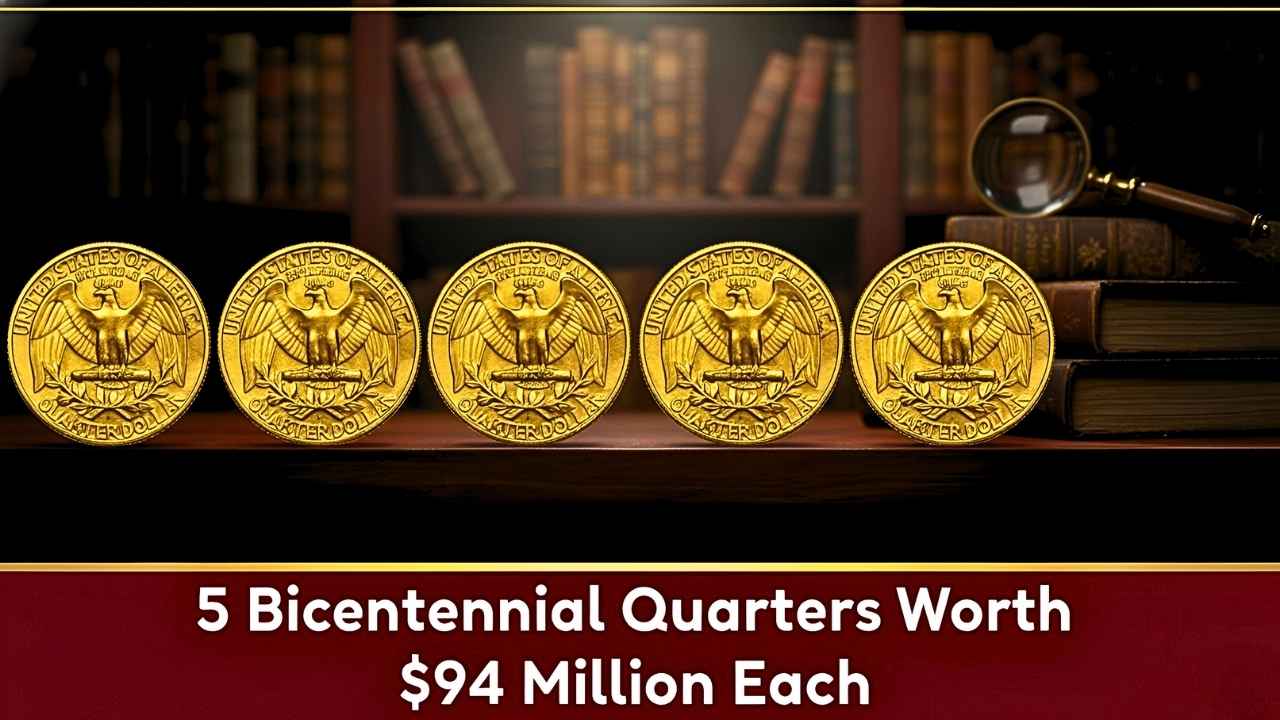
5 Bicentennial Quarters Worth $94 Million Each: When you think of rare and valuable coins, your mind may immediately jump to precious metals or historic mints. But what if we told you that a simple Bicentennial quarter, one of the most iconic U.S. coins ever produced, could be worth a staggering $94 million? Sounds like a fantasy, right? Well, it’s not. There are indeed five Bicentennial quarters in circulation that have been valued at this jaw-dropping price. But how did these coins become worth millions, and could one be hiding in your own collection? Let’s dive into the incredible story behind these rare coins and uncover how to determine if you’ve got one of these treasures.
The Bicentennial Quarter: A Brief History
In 1976, the United States celebrated its 200th anniversary, marking the occasion with special designs on its coins. The U.S. Mint issued a Bicentennial quarter featuring a unique reverse design—a depiction of Independence Hall in Philadelphia, where the Declaration of Independence was signed. This design, created by John D. Sinnock and designed by engraver Jack L. Ahr, replaced the traditional eagle reverse, making it a one-time design for this quarter.
In total, billions of Bicentennial quarters were minted to commemorate the nation’s birthday, making them an iconic part of U.S. coinage. These coins were not rare by default—they were mass-produced and widely circulated, and they were meant to be a symbol of American pride. However, as with any large production, some of these quarters were produced with errors that, over time, have turned them into highly sought-after collectibles.
The Mystery of the $94 Million Quarters
So, how did a simple Bicentennial quarter become worth $94 million each? The answer lies in an incredibly rare error that occurred during production. While most Bicentennial quarters are valued at face value or a modest premium for their design, five specific quarters were minted with a unique flaw—known as a “double die error.” This error happens when a coin die strikes a coin multiple times, causing the design to be “doubled” or misaligned.

These five coins were accidentally struck with not just one, but multiple dies, creating an unmistakable doubling effect on the date, the lettering, or even the design itself. This error was so subtle that, for many years, these coins went unnoticed in circulation, blending in with other Bicentennial quarters. But over time, as collectors began to examine their quarters more closely, they realized that a select few displayed this unusual doubling.
The doubling effect was found primarily on the “1976” date and the “Liberty” inscription. However, there are also reports of slight variations where other parts of the coin are affected by the error. The five coins in question were eventually graded and authenticated by top-tier numismatic organizations, making them one of the most valuable and sought-after coins in modern history.
The Great Value of the 5 Rare Bicentennial Quarters
So, what makes these five quarters worth $94 million each? The main reasons are their rarity, historical significance, and the sheer uniqueness of the error. Only five of these error coins are known to exist, making them exceedingly rare. They are not only a part of American history but also a prime example of a mistake in the coin-making process that turned out to be highly valuable.
Because these five quarters are so rare, they have become a symbol of the unpredictable nature of coin collecting. In some cases, coins with even the smallest imperfections or production errors can command eye-watering prices. However, the true value of these five Bicentennial quarters lies in their scarcity—there simply aren’t any more of them.
The $94 million valuation is a result of the high demand for rare U.S. coins among investors and collectors, who understand that owning one of these error quarters is an extraordinary opportunity. The price also reflects the historical importance of the coin, as the Bicentennial quarter was issued during a pivotal moment in U.S. history.
How Can You Tell If You Have One?
Now that we know how valuable these coins are, the big question is: Could you have one in your collection? While finding a $94 million Bicentennial quarter may seem like a far-fetched dream, it’s not entirely impossible—especially if you’ve been collecting coins for some time.
To check if you have one of the five rare error coins, you’ll need to carefully examine your Bicentennial quarters. Here’s what to look for:
- Double Die Error: The key feature of these valuable coins is the doubling effect. Look for a doubling of the digits in the date (1976) and the word “Liberty” on the obverse side of the coin. The doubling should be noticeable, with the letters and numbers appearing as though they have been struck more than once.
- Close Examination: Use a magnifying glass or a jeweler’s loupe to closely inspect your coin. The error is subtle, and without magnification, you may not notice it. The doubling will appear to “shift” or overlap slightly, especially in the areas of high relief.
- Mint Mark: Some of the rare coins also exhibit doubling in the mint mark area, although this is less common. Pay attention to the mint mark on the obverse (underneath the date) and check for any signs of duplication.
- Condition: If you believe you’ve found a double die error coin, make sure to assess its condition. Error coins in better condition (higher grades) will fetch significantly more than coins that are worn or damaged. High-grade examples can be worth exponentially more.
- Certification: Once you’ve identified a possible rare coin, it’s essential to have it certified by a reputable coin grading organization, such as the Numismatic Guaranty Corporation (NGC) or the Professional Coin Grading Service (PCGS). These organizations will authenticate the error and provide a grade that can help determine its market value.
What to Do if You Think You Have One
If you believe you’ve found one of the elusive $94 million Bicentennial quarters, don’t rush to sell it just yet. The first step is to ensure its authenticity and have it professionally graded. A coin that is not properly authenticated or graded could lose much of its value.
Once you’ve received certification, you can consider your options. If you decide to sell, be prepared for a potentially long process. Rare coins of this magnitude are typically sold through high-end auctions, where numismatic experts will ensure that the coin is sold to the right buyer at the right price.
Conclusion
While the idea of finding a $94 million Bicentennial quarter in your collection might seem like a dream, it’s not entirely out of reach. The story of these five rare error coins is a reminder of the unpredictable and fascinating nature of coin collecting. The 1976 Bicentennial quarter is a symbol of American history, and when combined with a rare error, it can become a prized possession worth millions.
If you’re an avid coin collector, it’s worth carefully inspecting your collection, especially your Bicentennial quarters. Who knows? You might just have one of these priceless treasures in your own jar of coins. Whether or not you find one, it’s clear that rare coins, even those with minor flaws, can hold incredible value.